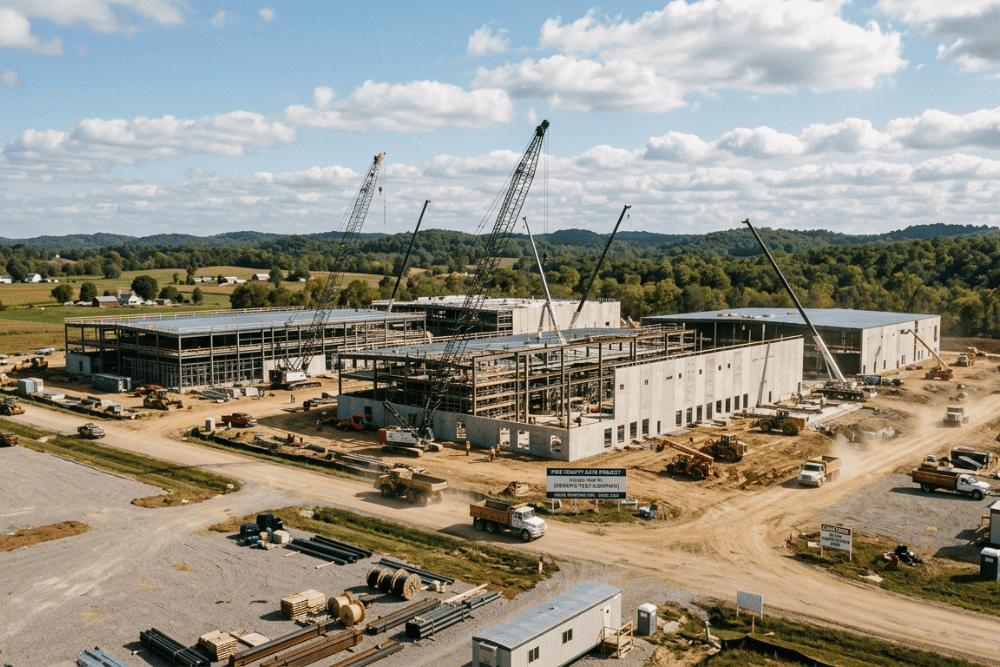
Data Centers and Responsible Growth

My Position
As co-owner of an IT networking and cybersecurity company, I understand the benefits and dangers of Data Centers. They are the physical infrastructure behind all our technology needs - cloud computing, streaming, gaming, online banking, and now artificial intelligence. But I also understand the fear and questions they generate.
Data centers have the potential to create tremendous amounts of innovation, investment, tax revenue, and new jobs for Ohio. But economic development only works when Ohioans benefit from it too - not just the large technology companies.
Any expansion of data centers into Ohio has to be done with reasonable protection to Ohioans, our environment and land, energy supply and costs, and tax revenue. My standard is simple: Ohio benefits or we don’t proceed.
What Are Data Centers
Data centers are large facilities filled with servers that store and process the data we need to run our modern world. Data centers are not new to Ohio. Commercial data centers have operated here for decades, including facilities in Cleveland and Cincinnati dating to the early 2000s.
What is new is their extraordinary scale. Ohio's hyperscale cloud era accelerated in 2015–2016 with Amazon Web Services' major investment in Central Ohio, followed by Facebook's New Albany announcement in 2017. Today, artificial intelligence is driving an entirely new generation of facilities whose electricity, water and land demands can dwarf the data centers of the past. They raise numerous questions about their benefits and concerns.
Benefits:
$40 billion in new investment in Ohio through 2030
Billions of projected state and local tax revenues, including $1 billion+ in 2024 alone
57,000+ construction jobs through 2030
7,000+ permanent jobs through 2030
Without property tax abatement, a data center can become one of the leading taxpayers in its county
Free training for high-paying data-center careers, including 250 fiber optic technicians and a growing pool of electricians
Concerns:
Can Ohio's power grid handle this demand? At what cost to Ohio energy users?
Can Ohio’s water supply handle this demand? At what cost to Ohio water users?
Are homeowners near the data centers protected from noise and air concerns connected to back up diesel generators?
Where will the data centers be located? Are there protections for communities and farmland?
Ohio's data-center sales-tax exemption has grown dramatically beyond its original projections, costing the state more than $1.5 billion last year. That raises a legitimate question: Are Ohio taxpayers receiving enough in return for that subsidy?
Far fewer permanent jobs will be created than temporary jobs
Neither list cancels out the other - but they make the case that protections are necessary rather than an outright ban.
The Current Landscape
Ohio has begun taking steps to protect ratepayers. In AEP Ohio's service territory, regulators approved a special data-center tariff in 2025 designed to prevent the extraordinary infrastructure costs created by large new data centers from being shifted to residential and business customers.
In March 2026, the House passed Bill 646 creating a Data Center Study Commission to examine farmland, noise, water use, energy demand, and other impacts. The Senate amended it to include: a separate electric rate class, offset requirements for facilities over 250 megawatts, water-use reporting to state agencies, and limits on the tax exemption that had been much more costly than anticipated. Governor DeWine paused the tax exemption in May 2026, and legislators are fighting over whether to restore it at 100, 50, or 0%. House Bill 646 and several companion bills — have stalled over that disagreement until the legislature reconvenes in November.
Locally, in September 2026, Westlake City Council voted unanimously to pause new data-center zoning and occupancy approvals for up to six months. Even though no data center is proposed at this time, the City wants time to make sure its zoning code addresses these facilities before one shows up.
What We Can Do
Make data centers pay their fair share. I support reviewing Ohio's data-center tax incentives — including the sales-tax exemption — to be sure taxpayers get a real return and these projects contribute fairly to the infrastructure their operations require. House Bill 646 already proposes cutting the exemption; lawmakers just can't agree on how far.
Protect residents from higher utility costs. Massive data centers, not families and small businesses, should bear the cost of the extraordinary power demand and grid upgrades they create. I'll support protections like the AEP tariff already in place, and House Bill 706's proposed 12-year utility agreements to keep those costs from shifting onto ratepayers.
Require water-use transparency. Ohio should require data centers to report how much water they draw - so utilities can plan for capacity needs, other users aren't crowded out, and the company creating the demand pays for the infrastructure it requires. House Bill 784 requires this kind of reporting.
Set noise and air-quality standards. Backup generators and cooling systems should undergo the same review as any other industrial facility. No bill at the Statehouse currently addresses this question. It’s a gap I'd work to close.
Give local communities a voice. Development decisions shouldn't be imposed on communities from Columbus. Local governments and residents deserve input into whether and where large data-center projects belong — the same authority Westlake City Council just exercised when it paused approvals to get its rules right before any project arrives. House Bill 983 would require a public vote before local zoning change or tax break for a data center — the right idea.
Protect farmland and green space. Ohio should prioritize using already-developed commercial and industrial sites (brownfield sites) before sacrificing productive farmland and open space for new facilities and infrastructure. No current bill addresses this either — I'd want to introduce it.
Demand transparency for taxpayer incentives. When a company receives a significant tax benefit, taxpayers deserve the return - measured by investment, permanent jobs, infrastructure costs and long-term benefit. House Bills 646, 695 and 983 move in this direction by limiting nondisclosure agreements.
Reach Out to Me
You can reach out to me and tell me your thoughts and concerns about Data Centers. Together we can make sure that Ohio and Ohioans benefit from expansion into the industries of the future.